The Ultimate Guide to Metal Accessories for Beauty Packaging
Materials, Processes, Costs & Everything In Between
Everything beauty and fragrance brands need to know — from material selection to supplier pitfalls.
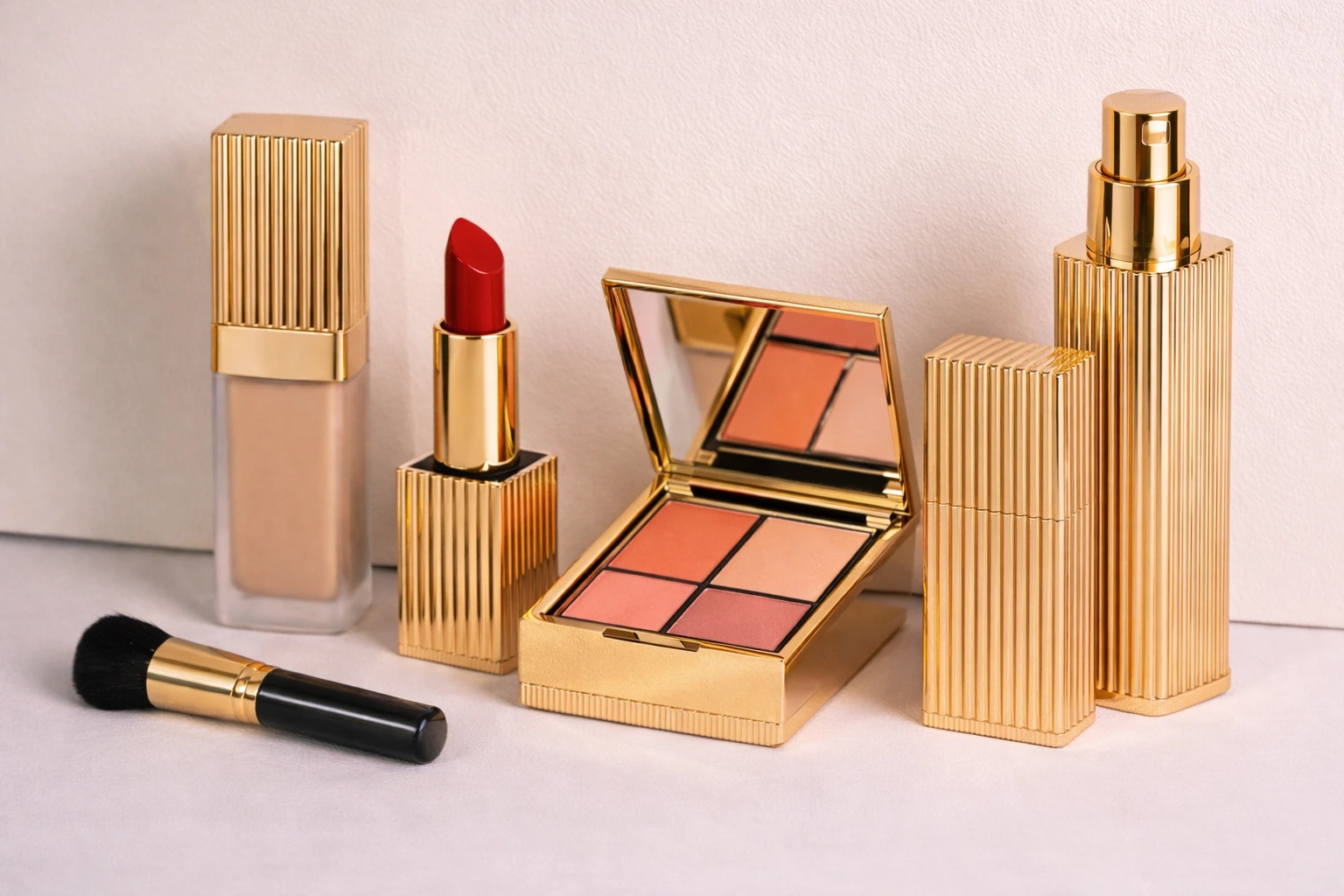
Walk into any high-end beauty retailer and you’ll immediately feel the difference between a premium product and everything else. A lot of that feeling comes from one place: beauty metal accessories. The weight of a perfume collar. The satisfying click of a compact lid. The way a brushed gold logo plaque catches the light.
These aren’t afterthoughts. For brands operating in the luxury or near-luxury space, beauty metal accessories are one of the most powerful tools available for communicating quality, building brand identity, and creating a shelf presence that actually converts. This guide covers everything — materials, manufacturing processes, cost structures, timelines, and the mistakes to avoid.
Why Metal Accessories Are Central to Beauty Packaging
The beauty market is crowded. A lot of products look the same online. But the brands that build lasting recognition are the ones that invest in physical details — and custom beauty accessories made from metal are one of the highest-impact places to invest.
Here’s what quality metal does for your packaging:
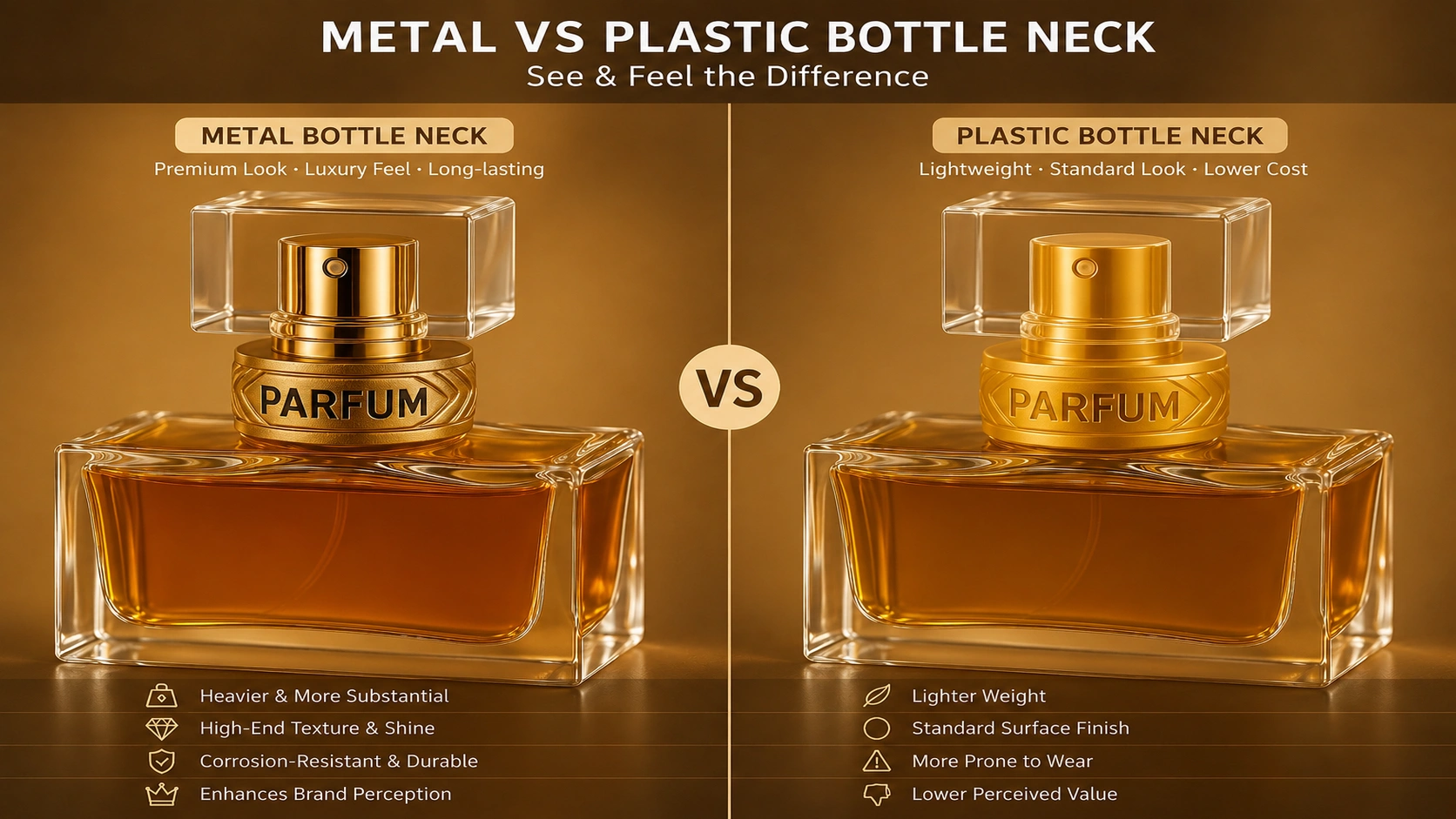
- Elevates perceived value — metal signals craftsmanship in a way plastic simply can’t
- Creates brand recognition — signature hardware becomes part of the brand identity
- Delivers shelf presence — a gold collar catches the eye; a generic plastic ring doesn’t
- Provides lasting quality — well-made metal holds up across the product’s entire life cycle
- Creates a sensory moment — the weight, the finish, the touch — these are emotional touchpoints
Part 1: Understanding Metal Materials for Beauty Packaging
Which metal is right for your perfume collar, compact lid, or lipstick case?
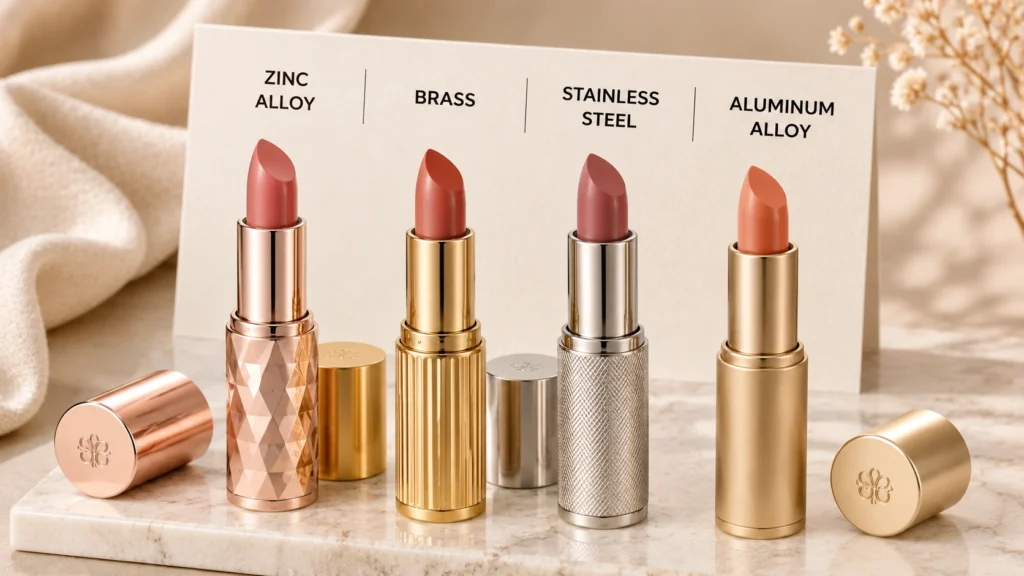
The three most widely used materials in beauty metal accessories are brass, stainless steel, and zinc alloy. Each comes with a distinct set of strengths, limitations, and ideal use cases. Choosing the wrong one early can create problems that are expensive to fix later.
1.1 Brass (H59 / H62) — The Luxury Standard
Best for: high-end perfume collars, sculptural ornaments, engraved logo plaques
Brass is the material that most luxury metal accessories are judged against. It has a natural warmth and density that’s hard to replicate, and it handles detail work — deep logo engraving, precise transitions, intricate surface textures — better than any other common metal.
- Engraving clarity: exceptional — holds fine details that remain crisp through plating and polishing
- Surface quality: naturally beautiful reflective surface that responds well to all major finishing types
- Plating compatibility: extremely stable — gold, rose gold, silver, and nickel-free options all perform well
- Weight and feel: premium density that communicates quality the moment someone picks up the product
- Cost: highest of the three common options
- Limitations: heavier, not suitable for ultra-lightweight or very thin-wall designs
When to choose brass: your design requires a genuinely high-end look, deep logo engraving, or sculptural fine detail.
1.2 Stainless Steel — Durable & Modern
Best for: minimalist designs, lipstick shells, compact mirrors, high-wear components
Stainless steel is the choice when durability and a clean modern aesthetic are the priorities. It’s scratch-resistant, corrosion-resistant without plating, and delivers a precision geometric look that works particularly well for contemporary or gender-neutral beauty lines.
- Durability: extremely high — resists scratching, corrosion, and daily wear better than other options
- Aesthetic: clean, modern, slightly industrial — pairs well with minimalist brand identities
- Plating: not always required — raw or brushed stainless has its own appeal
- Limitations: harder and more expensive to machine into organic or complex forms
When to choose stainless steel: durability is non-negotiable, or your design language is clean and geometric.
1.3 Zinc Alloy (Zamak) — Flexible & Cost-Effective
Best for: complex sculptural shapes, decorative ornaments, high-volume production
Zinc alloy is the workhorse of custom beauty accessories — not because it’s a compromise, but because it’s genuinely the best tool for certain jobs. Complex curved forms, organic shapes, and decorative elements with flowing geometry are all easier and more cost-effective to achieve in zinc alloy than in brass or steel.
- Design flexibility: excellent — handles complex molds, undercuts, and organic geometry well
- Cost: lowest of the three — makes high-volume and design-heavy projects more viable
- Plating: takes plating well when supplier quality is controlled; adhesion depends on surface prep
- Limitations: fine details can soften if mold tolerances aren’t tight; plating stability varies by supplier quality
When to choose zinc alloy: your design features flowing or sculptural geometry, or you’re working with large production volumes.
1.4 Aluminum Alloy — Lightweight Precision
Best for: lightweight cosmetic components, travel packaging, modern compact designs
An increasingly popular choice for brands that want the premium look of metal without the weight. Aluminum machines cleanly, anodizes well, and is particularly well-suited for brands where portability is a core product benefit.
- Weight: significantly lighter than brass or steel — ideal for travel-size and on-the-go products
- Finish options: anodizing creates durable, vibrant color options not easily achieved with other metals
- Machining: fast and clean — great for precision geometric components
- Limitations: softer than steel; not ideal for components that bear heavy mechanical loads
Part 2: Manufacturing Processes for Custom Beauty Metal Accessories
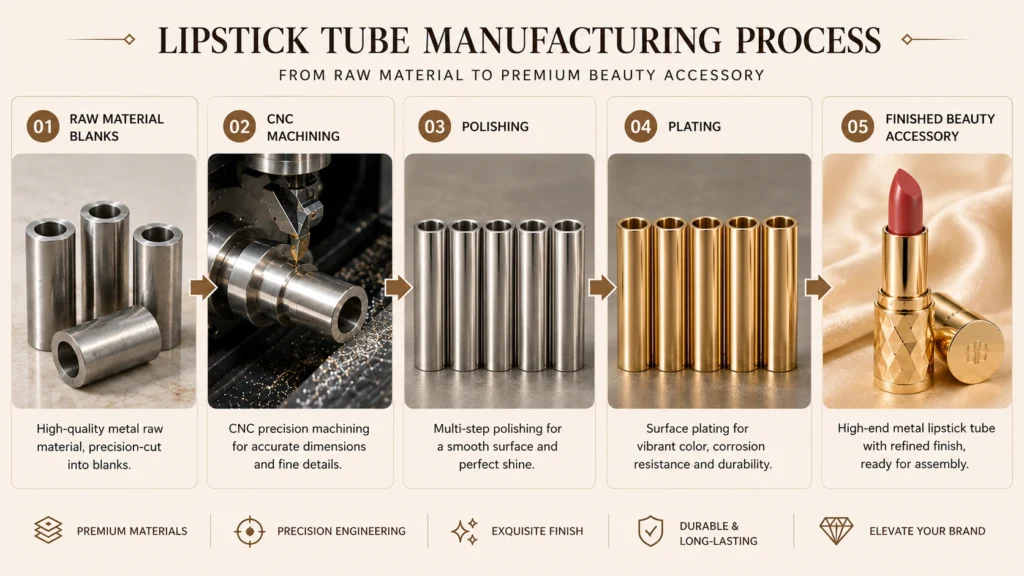
Knowing your material is only half the picture. The manufacturing process determines how well the design translates into a real, finished part — and how consistently it does so at production scale.
2.1 CNC Machining
CNC machining is the go-to for custom beauty metal accessories where precision and surface quality are paramount. A computer-controlled cutting tool removes material to exact specifications — which means sharp edges, deep engraving, and consistent geometry that holds up across every batch.
- Precision: highest available — tolerances down to ±0.02mm for critical dimensions
- Best for: logos, monograms, mechanical components, any design where edge quality matters
- Materials: brass, stainless steel, aluminum — particularly well-suited
- Cost: higher per unit, but often offset by reduced finishing rework
- Volume: ideal for low-to-medium runs, prototyping, and limited edition components
2.2 Die Casting
Die casting is the process behind most of the complex, organic-form beauty metal accessories you see on the market. Molten metal is injected into a steel mold under high pressure, capturing fine surface detail and complex geometry in a single shot.
- Design freedom: excellent — handles undercuts, flowing forms, and sculptural geometry
- Best for: zinc alloy components, decorative ornaments, complex 3D shapes
- Cost: medium — mold investment upfront, but low per-unit cost at volume
- Volume: most cost-effective at medium-to-high production quantities
2.3 Electroplating & Surface Finishing
The finish is what the customer sees and touches first. For luxury metal accessories, plating quality isn’t just about color — it’s about longevity, consistency, and the way light interacts with the surface.
- 24K Gold — timeless, warm, universally associated with luxury
- Rose Gold — romantic and contemporary, extremely popular across fragrance and cosmetics right now
- Silver / Nickel-Free Silver — clean and versatile, hypoallergenic option for skin-contact components
- Gunmetal / Black — edgy, modern, works well for unisex and niche positioning
- Matte / Satin — understated luxury, increasingly in demand for minimalist brand aesthetics
- Custom PVD Colors — when your brand color needs to show up on metal
Plating quality determines color stability, anti-tarnish performance, and how the product looks a year after purchase — not just on launch day.
2.4 Polishing
Polishing is often underestimated, but it’s what separates a metal component that looks good from one that feels genuinely premium. Proper polishing removes micro-scratches, evens out surface reflectivity, and prepares the metal for a plating layer that actually adheres uniformly.
- Mechanical rough polishing — baseline surface uniformity
- Fine surface polishing — removes tooling marks and minor imperfections
- Mirror polishing — high-reflectivity finish for gold and chrome-effect surfaces
- Hand finishing — edge refinement and detail preservation that machines can’t replicate
2.5 Engraving
For brand logos, textures, and fine patterns, engraving method matters:
- CNC engraving: deeper, more three-dimensional — creates the premium tactile quality associated with high-end brand hardware
- Laser engraving: faster and highly precise for fine lines and simple logos — ideal when speed and repeatability are the priority
Part 3: Cost Structure — What Actually Drives the Price
The most common question brands ask when sourcing custom beauty accessories: ‘How much does this cost?’ The honest answer is: it depends on five factors.
3.1 Material
Brass > Stainless Steel > Zinc Alloy > Aluminum. The material choice sets your cost floor before any other decision is made.
3.2 Mold Investment
Die-cast components require mold tooling upfront. Simple geometric molds are relatively low-cost; sculptural, multi-cavity molds are more significant investments. CNC-machined parts require no molds — the program is the tool.
3.3 Process Complexity
Each additional step adds cost. A component that requires CNC machining, hand engraving, dual-stage polishing, and electroplating costs more than a simple cast piece with a single-stage finish — because it takes more time and skill.
3.4 Plating Specification
24K gold plating costs more than silver. Nickel-free hypoallergenic plating adds a premium. Thick-layer plating for long-term durability costs more than standard thickness. The finish you choose has a real cost impact.
3.5 Order Quantity
Higher quantities spread fixed costs (molds, setup, QC) across more units — which reduces the per-unit price. Lower quantities produce the reverse. This is especially relevant for limited editions and early-stage brand development.
3.6 Packaging & Logistics
Often overlooked: individual component packaging, protective inner wrapping, and shipping configuration all contribute to total landed cost. Discussing these requirements upfront avoids surprises at the final invoice stage.
Part 4: MOQ & Development Timeline
Timeline is almost always the second question after cost. Here’s what to expect when developing custom beauty metal accessories with a reliable manufacturer.
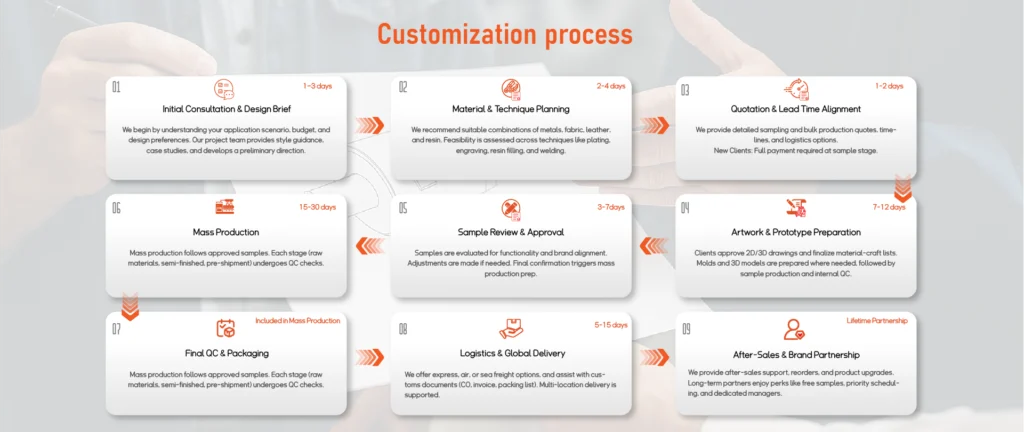
4.1 Standard Lead Times
- 3 days — concept sketches and initial design direction
- 7–12 days — prototype samples (physical, finished-surface samples for approval)
- 18–28 days — mass production after sample approval and order confirmation
These timelines assume clear design briefs and prompt feedback at each stage. Ambiguity and revision rounds are the most common reasons projects run over schedule.
4.2 Typical MOQ by Material
- Zinc Alloy: 500–1,000 pcs
- Brass: 300–500 pcs
- Stainless Steel: 200–300 pcs
MOQ also varies based on structural complexity and surface finish requirements. CNC-only components can sometimes be sampled at even lower quantities.
Part 5: Common Problems — And How to Avoid Them
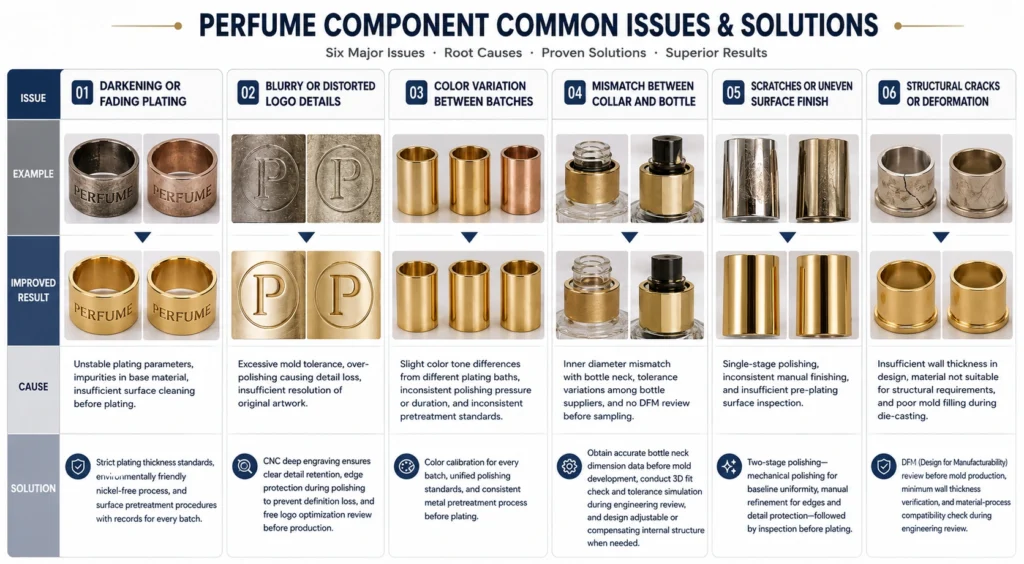
Even experienced sourcing teams run into issues with beauty metal accessories. Here are the most common ones — and what actually solves them.
5.1 Plating Turns Dark or Fades
Causes: unstable plating parameters, impure base materials, insufficient surface cleaning before plating.
Solution: strict plating-thickness standards, eco-friendly nickel-free processes, and documented pre-treatment protocols for every production run.
5.2 Logo Details Look Blurry or Soft
Causes: mold tolerances too loose, over-polishing removes fine details, low-resolution original artwork.
Solution: CNC deep engraving for crisp detail retention, edge-protected polishing to preserve definition, logo optimization review before production starts.
5.3 Batch Color Inconsistency
Causes: different plating tanks produce slightly different tones, inconsistent polishing pressure, variable pre-treatment between runs.
Solution: color calibration for every batch, unified polishing standards, consistent pre-treatment protocols before plating.
5.4 Perfume Collar Doesn’t Fit the Bottle
Causes: internal dimensions don’t match the bottle neck, tolerance variation between bottle suppliers, no DFM review before sampling.
Solution: request precise bottle neck dimensions before mold development, 3D fit check and tolerance simulation in the engineering review, adjustable or compensated internal structure where needed.
5.5 Surface Scratches or Uneven Shine
Causes: single-stage polishing, inconsistent hand-finishing, insufficient surface inspection before plating.
Solution: dual-stage polishing — machine polishing for baseline uniformity, hand finishing for edge refinement and detail preservation — followed by pre-plating inspection.
5.6 Structural Cracking or Deformation
Causes: insufficient wall thickness in the design, material choice mismatched to structural requirements, mold fill issues during die casting.
Solution: DFM (Design for Manufacturing) review before mold production, minimum wall thickness verification, and material-process compatibility check during engineering review.
How to Choose the Right Metal Accessories Supplier
The manufacturer you choose has as much impact on the final product as the design itself. When evaluating suppliers for custom beauty metal accessories, here’s what actually matters:
- Engineering capability — can they review your design for manufacturability before sampling? Do they flag potential problems proactively?
- Sample quality vs. production quality — ask to see production batch samples, not just showroom pieces. The gap between the two reveals a lot.
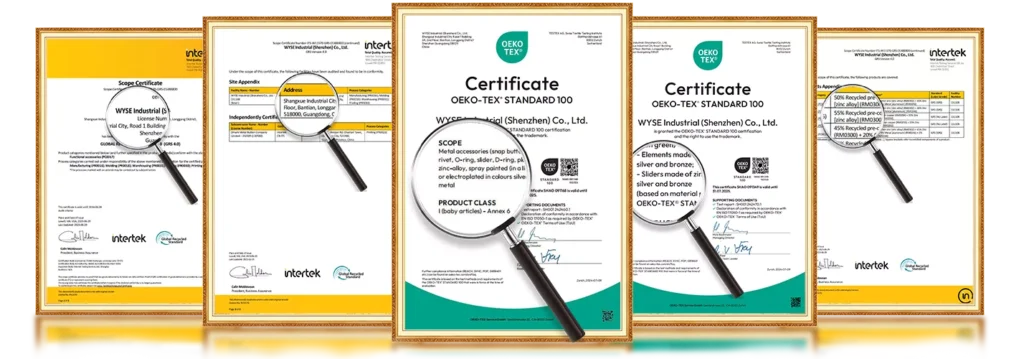
- Material transparency — can they provide material certifications and plating thickness documentation?
- Communication consistency — responsive during sampling usually means responsive during production. Slow communication early is a red flag.
- Sustainability practices — nickel-free plating, eco-friendly processes, and responsible material sourcing are increasingly important for brand alignment and market requirements.
- End-to-end capability — a supplier who can take a project from concept sketch to mass production under one roof reduces risk, coordination time, and quality inconsistency between steps.
Ready to Develop Your Custom Beauty Metal Accessories?
Beauty metal accessories and custom beauty accessories aren’t just packaging details — they’re the physical embodiment of your brand’s promise. The weight, the finish, the precision — customers feel all of it. Brands that get these details right build recognition that lasts.
Whether you’re starting from a sketch, a reference image, or an existing sample you want to improve, our engineering team can help you move from idea to finished component — with full transparency at every stage.
Send us your concept and we’ll provide a free feasibility evaluation within 24 hours.
Email: sales012@wysecn.com
Website: https://buttonarea.com
WhatsApp: +86 13688844607