A French Perfume Bottle Project: From Design Review to Finished Metal Accessories
How we developed a gemstone-topped Zamac cap and a curved brass label for a tapered glass fragrance bottle, including the production problems we had to solve.
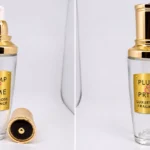
A while ago, we received an enquiry from a fragrance customer in France. The glass bottle had a distinctive shape: a tapered cylinder, wider at the top and narrower towards the bottom. Our job was to make two metal accessories that worked with it—a custom zamac perfume cap and a set of engraved brass labels.
From the outside, it might sound like a simple packaging order. But a good-looking drawing is only the beginning. We still had to turn fine decorative details into castable metal, shape a brass plate to fit a changing glass curve, and make sure the pieces that left our factory matched what the customer had approved.
We also wanted the two pieces to feel like they belonged on the same bottle. The polished gold cap brings weight and sparkle to the top, while the gold label carries the brand details across the front without overpowering the glass.
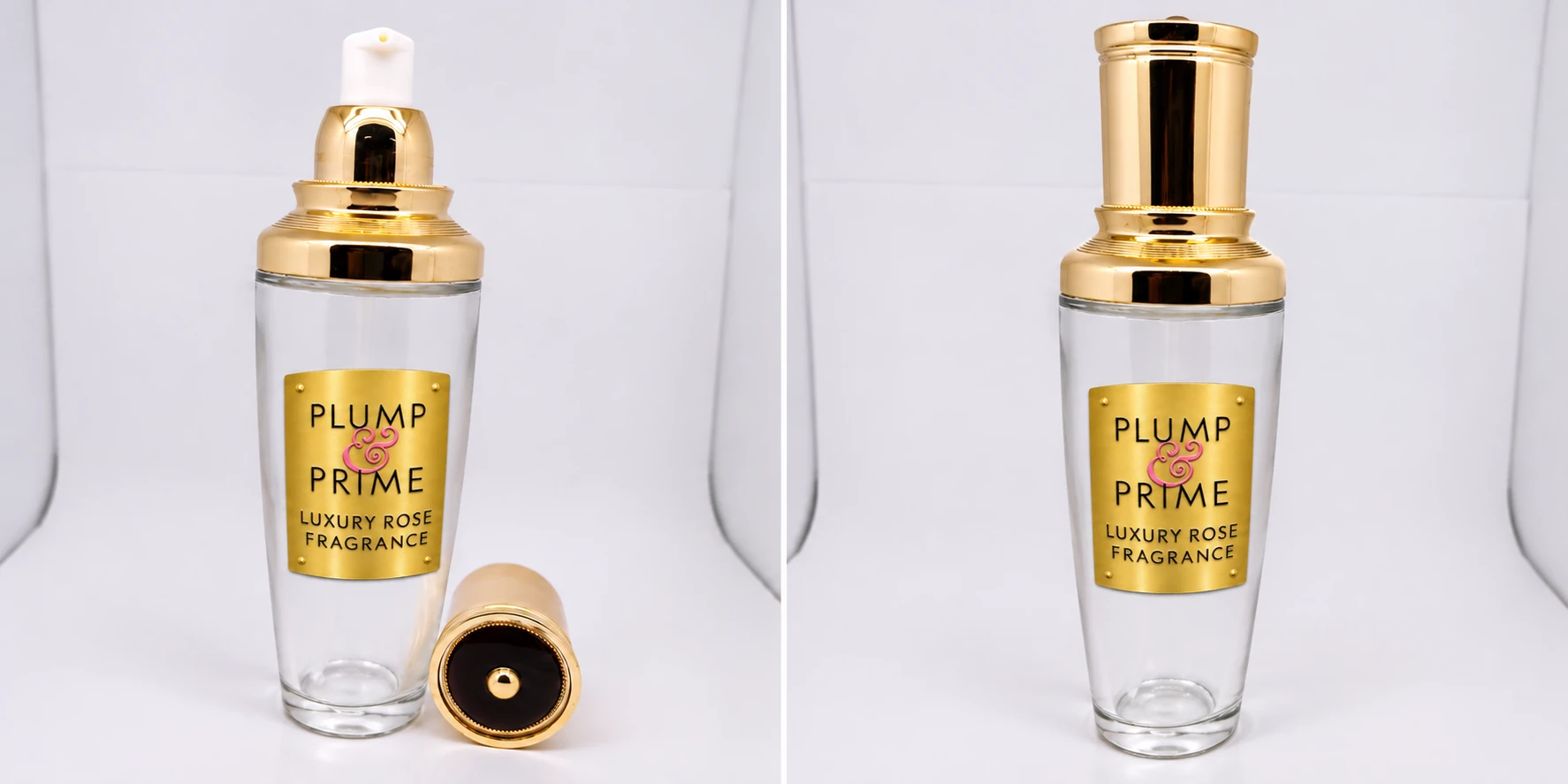
First, What Did We Make?
The gemstone-topped Zamac perfume cap
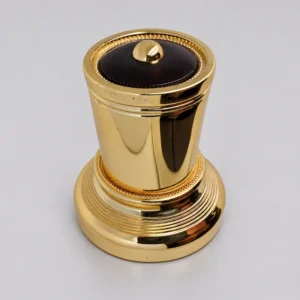
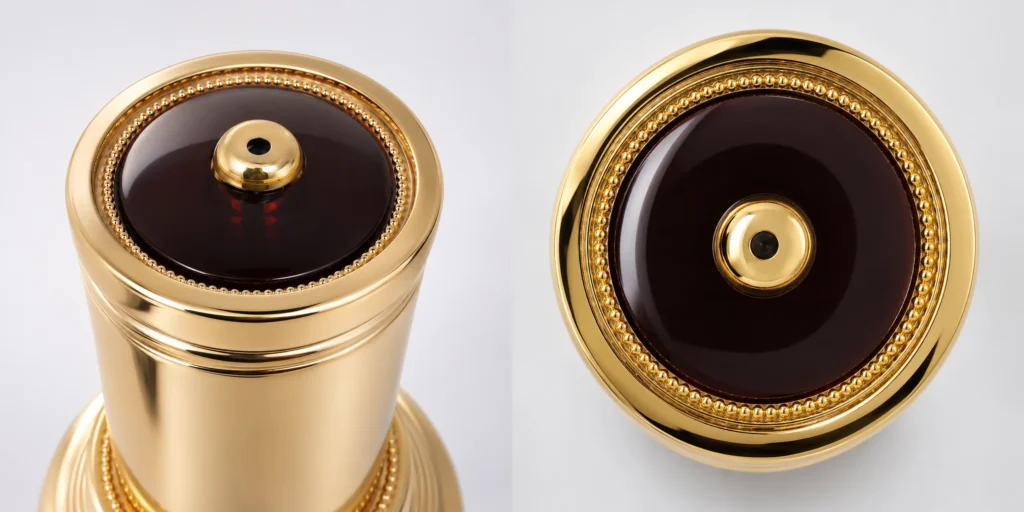
Our luxury fragrance cap has a clean, slightly tapered metal body with a brighter, more decorative top. The smooth gold sides give the bottle a solid finish, while the dark brown ring-shaped synthetic gemstone draws your eye to the cap. A fine circle of raised gold beads runs around that stone, with a small gold detail in the centre.
The product measures about 40 mm high, with a 36 mm top diameter, a 30 mm bottom diameter and a weight of around 25 g. The bright gold finish uses PANTONE 871 C as a colour reference; the dark brown synthetic gemstone uses PANTONE 4975 C. The stone is approximately 26 mm across, with a 6 mm centre opening and 3 mm height. The physical plated colour still needs to be signed off against a real sample, not judged from a screen alone.
The curved brass front label
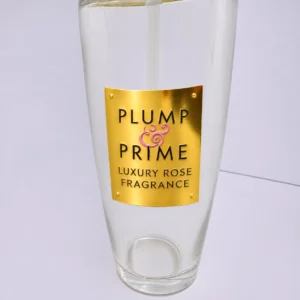
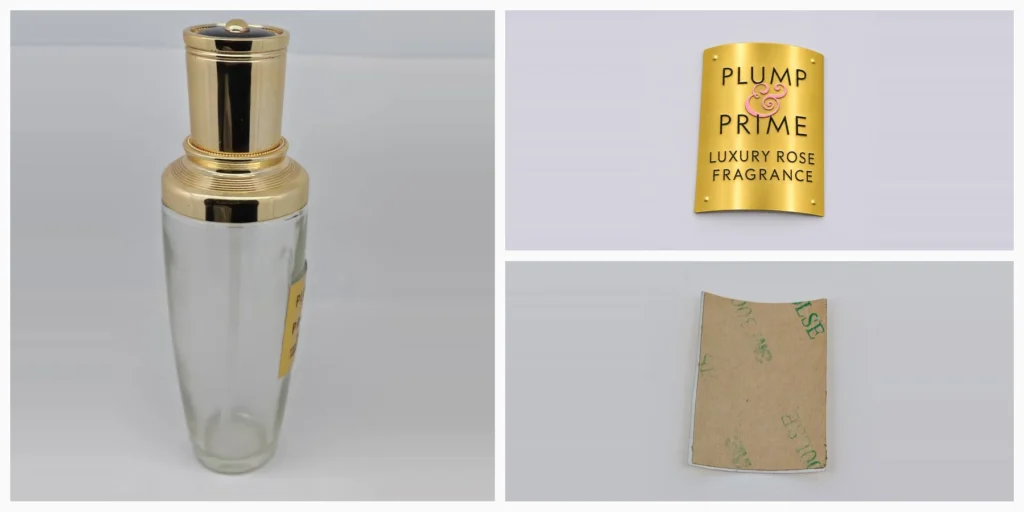
The engraved brass labels were a different kind of challenge. These were not flat plates to be stuck onto an ordinary rectangular bottle. The glass became narrower as it went down, so the label had to follow that profile. Its upper edge is wider than its lower edge, and the curvature has to match the bottle at both ends—not simply use one bend from top to bottom.
Each label is approximately 40 × 30 × 1 mm, with raised lettering and decorative embossing of about 0.5 mm. The front is bright gold, with black text and a pink logo; the reverse has a silver-white finish and 3M self-adhesive backing. In this design, the dimensional lettering is formed by stamping/embossing. The trade name engraved brass labels should not be mistaken for a claim that every raised detail is cut by a separate engraving process.
From Enquiry to Shipment: The Route We Followed
Enquiry → design discussion → production review → CNC mold development → sampling → samples sent for customer approval → bulk production → first inspection → electroplating → second inspection → packing and shipment.
We started with the customer’s ideas and the bottle shape. During design discussions, we checked what the client wanted the finished bottle to look like and how each accessory would sit against the glass. Before cutting the tooling, we reviewed whether the details could be made consistently with our chosen processes.
Next came mold development and sampling. We made samples, sent them back for the customer’s review, and worked from the approved result when moving into volume production. The extra inspection points were deliberate: finding a casting or stamping fault before plating costs far less than discovering it after every finishing and assembly step.
A signed-off sample gives both sides something tangible to compare—the cap fit, gold appearance, small bead details, label curve, print position and overall balance on the actual bottle. It reduces the chance of different people interpreting the same artwork in different ways.
How We Made the Zamac Cap—and Fixed the Tiny-Bead Problem
For the cap body, we chose high-quality zinc alloy and die casting. Zinc alloy has a relatively low melting point and good fluidity, which makes it a practical material for decorative pieces with sculpted features. After suitable surface preparation and electroplating, it can also take on the smooth, bright finish expected from premium fragrance packaging.
Compared with a typical plastic cap, the finished metal cap feels more substantial in the hand. That weight and cool metal touch are part of the appeal for luxury packaging. We also value the plated surface for its appearance and potential durability, while recognising that actual wear and corrosion performance depend on the coating specification and use conditions.
The issue we met at the casting stage
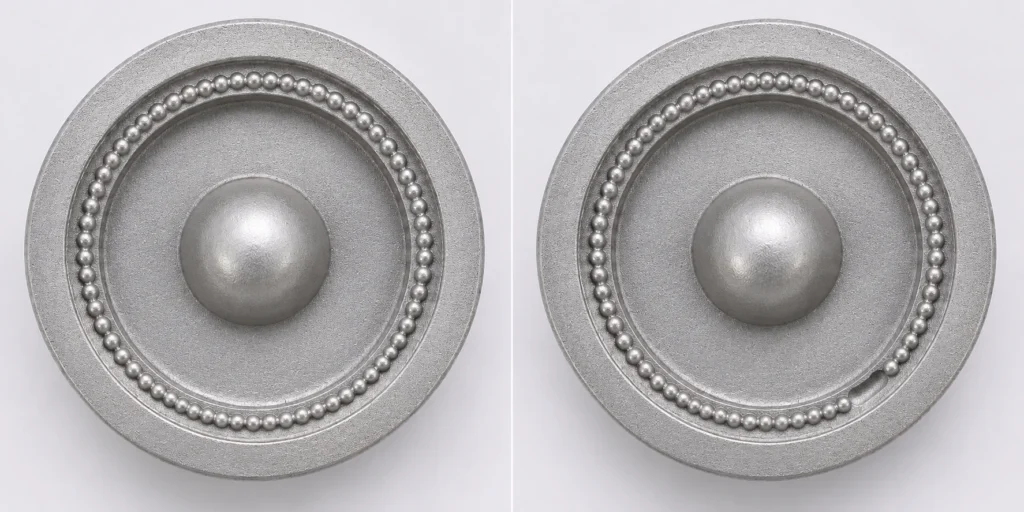
The trickiest part was not the broad cylindrical body. It was the fine circle of little raised dots around the gemstone. During die casting, some dots could come out incomplete or lose their shape. At first glance, it is a tiny flaw. On a polished gold cap, however, that kind of irregularity is easy to spot.
We made a small adjustment to the CNC-machined mold so the molten metal could fill that detailed area more smoothly. We then paid particular attention to those dots during the first inspection and separated out parts with missing or distorted details instead of carrying them into plating.
Once a tiny casting defect has been covered in shiny plating, it does not become less visible—it often stands out more. Checking the bare metal first helped us focus the finishing work on parts that had already passed the structural and appearance review.
Our cap production sequence: die casting → initial inspection → gold electroplating → gemstone assembly → final inspection → packing and shipment.
After plating, we assembled the synthetic gemstone and checked the cap again. This time our attention went to the gold colour, surface scratches, gemstone position, the raised decorative details and the overall appearance beside the approved sample.
How We Made a Brass Label Fit a Tapered Bottle
With the label, we took another route: brass and stamping. Brass is ductile enough to be formed into a shaped plate and is well suited to fine decorative work. The bottle’s changing diameter meant we could not treat the label like a flat sticker or give it one constant curve.
We had to account for the upper and lower sections of the bottle separately. The goal was a metal label that sat neatly against the glass, with no awkward gap at one end and no forced fit at the other. For metal labels for glass bottles, that bottle-to-label fit matters just as much as the lettering or the finish.
The alignment issue we caught
During production, we encountered a slight offset between the stamped logo/text details and the screen-printed artwork. It was small, but when the pink logo, black text and raised metal detail are supposed to work together, even a small shift can make the label look unfinished.
We modified the lower positioning fixture so it located the brass part more accurately, and we tightened the operating instructions for registration between the processes. At inspection, we removed labels that showed unacceptable misalignment instead of hoping that the difference would go unnoticed after application.
Our brass-label sequence: shape stamping → electroplating → screen printing → logo and lettering stamping/embossing → inspection → 3M adhesive backing assembly → final inspection → packing and shipment.
We also recommend confirming the actual bottle surface before final application. A curved metal label needs both the correct formed profile and an adhesive system suited to the glass, surface cleanliness and handling conditions. The current product uses 3M adhesive backing, but a real bottle test is the sensible way to confirm the fit.
Why We Inspected the Parts More Than Once
We have always paid close attention to the tools and the samples, but volume production can still produce occasional rejects. That is exactly why we do not leave quality inspection until the cartons are ready to close.
For the cast cap, the early check focused on whether the metal had formed correctly—especially the fine dots, edges and decorative features. After electroplating and gemstone assembly, we checked the finish and the assembled appearance again. For the brass labels, we looked at stamping accuracy, printed registration, surface condition, label curvature and adhesive application at the relevant stages.
A good inspection process is not a promise that manufacturing will never produce a flawed part. It is how we identify problems, correct the cause where we can, and prevent nonconforming pieces from becoming the customer’s problem.
What We Would Ask for on Your Next Fragrance Project
If you are developing a cap or a brass label for a fragrance bottle, these are the details that help us give useful feedback before tooling begins:
- The bottle drawing, 3D file or a physical glass sample, including the taper and bottle-neck dimensions.
- The sprayer or pump specification and any internal cap-fit requirements.
- Artwork with legible small details, approved logo files and the position of printed and raised elements.
- Preferred metal finish, gemstone colour, physical colour reference and the look you want across the full bottle.
- Expected order quantity, target delivery date, packaging requirements and any tests your project needs.
The Part We Value Most
The best moment in a project like this is not simply seeing a shiny cap or a finished label. It is seeing two different metalworking processes come together on one glass bottle, after the design has been checked, the tricky details adjusted and the samples approved.
This French order reminded us that luxury packaging is built in the small decisions: a better-filled bead around a gemstone, a label curve that matches real glass, or a print position that lines up exactly where it should. We take those decisions seriously because they are the details a customer will notice in the finished product.
Have a perfume bottle or fragrance packaging idea in mind? Send us your bottle drawing, reference images or sample, along with the metal finish and quantity you are considering. We will review the project with you and get back to you within 24 hours.
Contact ButtonArea
Email: sales012@wysecn.com
Website: https://buttonarea.com
WhatsApp: +86 13688844607
FAQ
Frequently Asked Questions About

Need project advice?
Add Your Heading TeOur team can review your drawing and recommend the right mold-making approach for your metal accessory project.xt Here
Drawing review
Structure optimization
Mass-production support
01. How do you prevent small decorative details from being lost during Zamac die casting?
Fine details can sometimes be difficult to reproduce consistently during die casting. In this project, some of the tiny raised beads around the gemstone were incomplete. We adjusted the CNC-machined mold to improve metal flow and checked these details before electroplating to prevent defective parts from moving to the next stage.
02. How do you make a curved brass label fit a tapered perfume bottle?
We design the brass label around the bottle's actual shape rather than using a standard curve. Since the glass bottle is wider at the top and narrower at the bottom, we adjust the label's width and curvature to match both sections. We also recommend testing the finished label and its adhesive backing on the actual glass bottle before final approval.
03. How do you keep printed logos and embossed lettering aligned on metal labels?
Accurate alignment depends on proper positioning during each production step. In this project, we found a slight offset between the screen-printed artwork and the stamped details. We improved the positioning fixture, refined the operating instructions, and inspected the finished labels to make sure the printed and embossed elements lined up correctly.
04. What quality checks do you perform on custom perfume caps and brass labels?
We inspect the products at different stages rather than waiting until final packing. For Zamac perfume caps, we check casting details, edges, plating color, surface scratches, and gemstone placement. For brass labels, we inspect stamping accuracy, printed alignment, surface finish, curvature, and adhesive backing. Finished products are compared with the approved samples before shipment.